
© Copyright PAL Impact Foundation 2025. All Rights Reserved
PALIF Chairman Basudeb Pal Discusses the Interplay of Technological Progress, Generational Change and Human Responsibility in the AI Era at IIT (BHU) Global Alumni Meet 2026
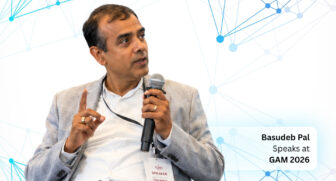
CHICAGO, September 2026 — Basudeb Pal, Founder and Chairman of PALIF, joined the IIT (BHU) Global Alumni Meet 2026 in Chicago. An Electrical Engineering alumnus from IIT (BHU)’s 1989 batch, he took part alongside alumni and leaders from different generations and professional backgrounds. Held on September 5–6, 2026, the event brought together the global IIT (BHU) community for discussions on technology, leadership and entrepreneurship.
The program centered on “Human Potential, Machine Intelligence: Building and Leading in the AI Era,” with Chief Guest Shri Manoj Sinha, Lieutenant Governor of Jammu & Kashmir, addressing attendees on technology, India’s development and the role of IIT (BHU) alumni. GAM 2026 featured discussions on technology, leadership, careers, entrepreneurship, and the changing nature of work.
Within this wider program, Basudeb joined B.V. Jagadeesh and Pushpendu Pal on the panel “Corporate IT in the AI Era & the SaaSocalypse.” The discussion focused on the impact of AI on corporate IT, the growing role of AI agents, and questions around safety, ethics, compliance, accountability, and human judgment.
A key part of the discussion was the need to view AI alongside the other technological and societal changes happening at the same time. Looking at previous periods of technological transformation, Basudeb noted that major shifts rarely come from one development in isolation. Economic growth, population changes, and advances in other technologies can all contribute to the transformation taking place.
As he put it, “I think AI is one of those things. We are ignoring many other things because we are so much excited with AI.”
That broader view extended to developments in astrophysics, biology, quantum technology, and green technology, as well as political and social changes. The discussion also considered how these forces could interact with the experiences and outlook of the next generation.
Generational change was another part of Basudeb’s perspective.
He questioned the tendency to dismiss younger people as the “snowflake generation,” pointing instead to the experiences that have shaped them, including living through COVID and rapid technological change. In his view, these experiences have given younger generations perspectives that previous generations did not have.
The panel also turned to the practical implications of AI agents taking on work traditionally performed by people. As these systems become more capable, questions around how they are governed, how information is protected, and who remains responsible for their outcomes become increasingly relevant.
Safety, ethics, information protection and compliance therefore form an important part of responsible AI deployment. The question of accountability becomes particularly significant when decisions and tasks move from people to AI systems.
Accountability mechanisms need to be built into these systems rather than addressed only after something goes wrong. Organisations adopting AI, technology providers and other stakeholders must ensure these mechanisms are in place.
As Basudeb noted, “Accountability is going out of human hands, and that's one of the big research and applied areas that we all have to think about.”
The discussion closed on the uncertainty surrounding where AI may ultimately lead. With AI developing alongside changes in science, technology, society, and generational attitudes, the destination is difficult to predict.
Basudeb nevertheless expressed optimism about what these forces could produce together, concluding that “there's a lot more to come.”
Watch the full panel discussion for the conversation behind these questions and Basudeb’s perspective on what comes next: Panel Session on “Corporate IT in the AI Era & the SaaSocalypse”, IIT (BHU) GAM 2026, Chicago
About PALIF
PAL Impact Foundation (PALIF) is a nonprofit organisation focused on using technology for inclusive and sustainable development. Its work spans education, public health and ethical innovation, with a focus on solutions that empower underserved communities and advance digital equity.